

Retirement Planning for the Future You Envision in Houston
Your retirement dreams shouldn’t feel out of reach. Our Houston retirement planning team helps turn your hard work into a lifetime of financial confidence.
- Build reliable income
- Simplify complex decisions
- Protect and grow your wealth

What Is Retirement Planning?
Retirement planning is the work of coordinating the financial decisions that determine how you live after your last paycheck. It covers considerably more than choosing investments. A retirement plan connects your income sources, your tax situation, your healthcare costs, and your long-term goals so each decision supports the others instead of working against them. If managed in isolation, those same decisions tend to undercut one another.
The shift itself is the hard part. For decades the focus was how much you had saved. Once retirement begins, the question is how to turn what you saved into income that lasts. Those are different problems that require different strategies. Our guide to retirement planning in Houston covers the subject in more depth.
Retirement Income Planning: Turning Savings Into a Paycheck
Retirement income planning is the process of turning accumulated savings into steady, sustainable income. It’s the part of retirement most people underestimate, because nothing in the saving years prepares you for it.
A retirement income strategy generally covers:
- Creating tax-efficient withdrawal sequences across your accounts
- Managing Required Minimum Distributions once they begin
- Coordinating Social Security with your other income sources
- Balancing continued portfolio growth against income stability
- Preparing for periods of market volatility
- Adjusting withdrawals as your circumstances change
Rigid rules of thumb often don’t hold up in practice. A flexible income strategy adapts alongside markets, tax law, and your own priorities, which matters across a retirement that may run 25 to 30 years or longer.


Investment Considerations in Retirement
Your portfolio still has work to do after you retire. It has to keep pace with inflation over a retirement measured in decades while also producing income you can count on, and those two jobs pull in different directions.
Our investment management approach rests on four elements: a global perspective drawn from economic trends and market conditions, a fundamental focus on what companies do well, technical timing on when to buy and sell, and a risk-managed strategy that balances growth against protection.
In retirement, that last element carries more weight. Drawing income from a portfolio during a downturn is a different situation from riding out the same downturn while you’re still collecting a paycheck, and a retirement plan should account for the difference.
Tax-Aware Retirement Planning in Texas
Texas has no state income tax, which lets many retirees keep more of their retirement income. But that advantage is not the whole tax picture.
Property taxes in Texas run higher than in many states, and they stay one of the largest ongoing expenses for Houston retirees. Building them into long-term cash flow projections produces a far more realistic view of what retirement will cost.
Federal taxes still apply as well. Withdrawals from tax-deferred accounts are generally taxable, and the order in which you draw from your accounts can influence your tax bill, your Medicare premiums, how long your portfolio lasts, and how much passes to the next generation. Coordinating those decisions inside your broader financial plan, rather than handling them one at a time, is where tax-aware planning makes a big difference.


Social Security and Healthcare Decisions
When to claim Social Security is among the more consequential decisions in retirement. The right answer depends on your other income sources, your tax situation, your health, and your spouse’s circumstances. It’s as much about coordination as it is timing.
Healthcare deserves equal attention. Many people retire before they are eligible for Medicare, and covering that gap can cost more than expected when it hasn’t been planned for. Once Medicare begins, your taxable income can affect what you pay in premiums, which ties healthcare directly back to your withdrawal strategy. Our pre-retirement checklist covers what to handle before you leave the workforce.
Retirement Planning at Every Stage
What retirement planning looks like depends on how close you are to it.
In your 40s, peak earning years usually arrive with competing demands. Retirement savings, a mortgage, college costs, and career growth all pull at the same income. This is a good window to raise contributions and reduce unnecessary debt.
In your 50s, retirement stops being abstract and the planning gets more detailed. Catch-up contributions, tax-efficient savings strategies, healthcare planning, and retirement income projections all move up the list.
In your 60s and beyond, the work shifts from accumulating assets to producing income. Social Security timing, withdrawal sequencing, Required Minimum Distributions, healthcare costs, and legacy planning move to the center of the plan.
Wherever you are, planning widens the range of choices available to you. It’s rarely too late to strengthen a retirement strategy.

Working With a Houston Retirement Planning Advisor
A retirement planning advisor coordinates decisions that affect one another over many years. Working with an advisor based in Houston adds local knowledge to that work: the Texas tax environment, the compensation structures used by Houston’s major employers, energy industry retirement considerations, business-owner succession questions, and local cost-of-living realities.
Houston’s workforce brings its own complications; restricted stock units, stock options, bonuses, deferred compensation, and executive benefit packages all need coordination to avoid unnecessary taxes. Business owners often find their retirement depends on succession planning, a valuation, and an eventual liquidity event as much as on their investment accounts.
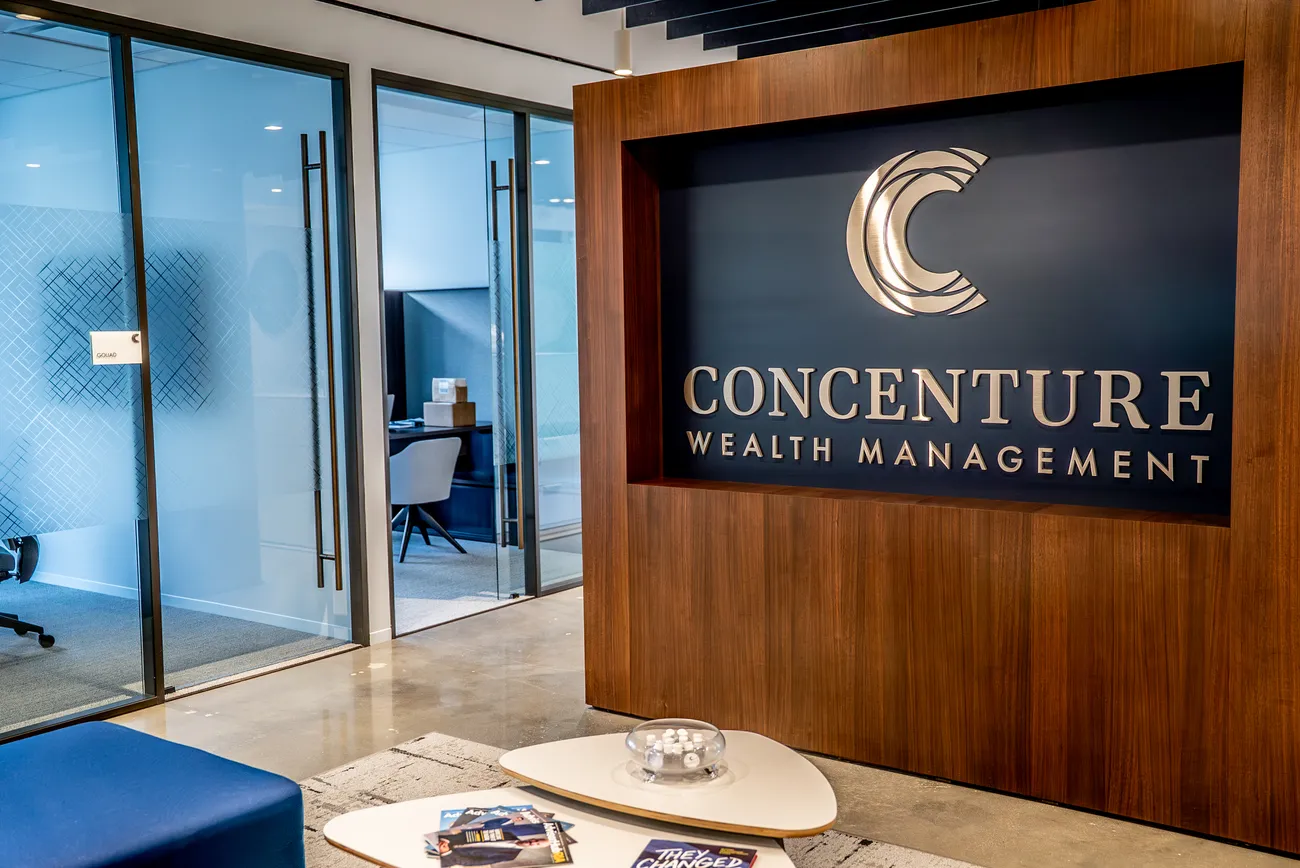
Our Houston office is located at 15377 Memorial Drive, and we work with clients across the Energy Corridor and the surrounding communities. Our team brings over 60 years of experience, led by founder Robert G. Gilliland, CRPC®, Managing Director and Senior Wealth Advisor, alongside Senior Wealth Advisor Karen E. Heider, CRPC®, CDFA®, BFA™, and Chief Investment Officer Mike W. Alexander, CIMA®. Concenture Wealth Management is a Sanctuary Wealth partner firm.
Our retirement planning services bring income planning, investment management, tax-aware strategies, Social Security coordination, healthcare considerations, and legacy planning into a single strategy rather than delivering them as separate pieces. Which of those carry the most weight depends entirely on where you are and what you’re working toward.
Our three-step process starts with a conversation about what you want retirement to look like, not with a product recommendation. It costs nothing to begin.
Frequently Asked Questions
What is retirement income planning?
Retirement income planning is the process of converting savings into reliable income once you stop working. Where retirement saving focuses on growing a balance, income planning focuses on drawing that balance down in a way that lasts.
In practice it means sequencing withdrawals across taxable, tax-deferred, and tax-free accounts, coordinating Social Security with your other income, managing required minimum distributions, and keeping enough growth in the portfolio to stay ahead of inflation. Each of those decisions affects the others, which is why they work better handled together than separately.
How much money do I need to retire in Houston?
There is no universal number. What you need depends on the lifestyle you want, your expected expenses, the age you retire, your other income sources, how long you live, and inflation.
Two people with identical portfolios can end up in very different places depending on how they manage withdrawals, taxes, and healthcare. A personalized retirement income projection gives you a far more useful answer than a generic benchmark. We cover this in more depth in our article on how much money you need to retire in Texas.
When should I start retirement planning?
The earlier you start, the more flexibility you have and the longer your investments have to compound. That said, it’s hardly ever too late to improve a retirement strategy.
People already approaching retirement, or recently retired, can often strengthen their position considerably through better tax planning, coordinated withdrawals, and a clearer income strategy. The planning work changes depending on your stage, but there is useful work to do at every one of them.
Does Texas offer tax advantages for retirees?
Yes. Texas has no state income tax, which allows many retirees to keep more of their retirement income than they would in other states.
Federal taxes still apply, though, and withdrawals from tax-deferred retirement accounts are generally taxable. Property taxes in Texas also run higher than in many states and remain a significant ongoing expense throughout retirement. Coordinated tax planning that accounts for all three tends to produce better long-term outcomes than focusing on the state income tax advantage alone.
When should I claim Social Security?
It depends on your situation, and it’s smart to think it through carefully rather than defaulting to the earliest eligible date.
The decision interacts with your other income sources, your tax bracket, your health, your spouse’s benefits, and how long you expect the money needs to last. Claiming earlier means smaller payments over a longer period; claiming later means larger payments over a shorter period. We look at Social Security as one component of your overall retirement income strategy rather than as a standalone decision.
What happens to my 401(k) when I retire?
You generally have several options, one of which is a rollover. The route that’s best for you depends on your plan’s features, your investment options, the fees involved, and how the account fits into your broader retirement income strategy.
This is a decision to review rather than default on, particularly if you hold employer stock or have a plan with unusual features. Our financial guides cover several of the questions that come up, and we work through the specifics with clients directly.
How do I plan for healthcare costs before Medicare?
Many people retire before they turn 65, which leaves a gap between their last day of employer coverage and the start of Medicare eligibility.
That gap is a common source of unexpected retirement expenses. Planning for it ahead of time keeps it from disrupting your income strategy in the first years of retirement, when the plan is still settling. Healthcare costs also continue to matter after Medicare begins, since your taxable income can affect what you pay in premiums.
What are required minimum distributions and how do they affect my plan?
Do you work with employees of Houston energy companies?
Yes. Houston’s energy workforce often has benefits packages, retirement plan options, and stock components that do not resemble a standard 401(k), and the timing of decisions around them is significant.
We maintain dedicated resources for employees of BP, Shell, Chevron, ExxonMobil, ConocoPhillips, and Phillips 66, covering the retirement questions specific to each employer.
How often should I review my retirement plan?
At least once a year, and sooner if anything significant changes.
Retiring, selling a business, receiving an inheritance, a change in tax law, a stretch of market volatility, or a major healthcare development are all reasons to revisit the plan rather than wait for the annual review. Regular reviews keep the plan aligned with your goals as those goals move. You can reach us through our Houston office whenever something comes up.
“The best financial decisions aren’t about predicting the future — they’re about preparing for it.”
– Karen Heider
What our clients say about us
Reviews are sourced from independent third-party platforms and reflect the experiences of individual clients. Concenture Wealth Management does not control, edit, or provide compensation for reviews. Testimonials are not necessarily representative of all client experiences and do not guarantee future performance. This review was provided by a current client. There are no conflicts of interest affecting its content. Additional reviews are available on our Google Business Profile.
Experience the Concenture difference
Choosing Concenture for your retirement planning means:
- A clear plan to turn your savings into reliable income
- Smart strategies for Social Security and 401(k) rollovers
- Investment approaches that grow with you and protect your assets
- Peace of mind knowing your retirement plan adjusts as life changes
- Confidence to enjoy retirement the way you’ve always imagined
Retirement doesn’t have to be complicated. Let’s make it work for you.